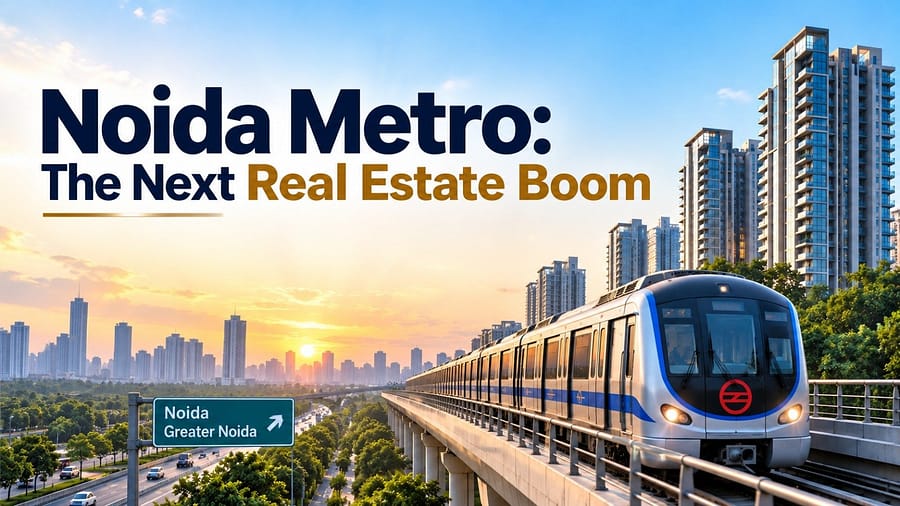
Noida and Greater Noida are entering another important phase of infrastructure-led growth. With new residential communities, commercial districts, corporate offices and large-scale developments emerging across the region, connectivity has become one of the biggest factors shaping the future of the National Capital Region (NCR).
Now, the Noida Metro Aqua Line is set for another major expansion, with Larsen & Toubro (L&T) selected to construct two proposed corridors — Sector 142 to Botanical Garden and Depot Station to Boraki Multi-Modal Transport Hub (MMTH).For commuters, the projects promise better connectivity. For businesses, they could improve access to important employment centres. And for the real estate market, the proposed metro corridors could strengthen the appeal of several strategically located areas across Noida and Greater Noida.
The development is therefore more than just another metro expansion. It is part of a much larger story about how infrastructure can influence the way people live, work and invest.
The Noida Metro Rail Corporation (NMRC) invited tenders for the two proposed corridors, with Larsen & Toubro emerging as the lowest bidder among nine agencies.The selection of the construction company is an important step for the projects and brings the proposed extensions closer to implementation.The two corridors have different purposes but together could create a more connected transportation network.The first corridor will connect Sector 142 with Botanical Garden, creating a potential link between the Aqua Line and Delhi Metro.The second will extend the existing network from Depot Station to Boraki MMTH, creating a connection between the Aqua Line and a proposed multimodal transport hub.
The significance becomes clearer when these projects are viewed in the context of the existing Aqua Line.
The existing Aqua Line currently connects Noida Sector 51 and Depot Station in Greater Noida.The operational corridor covers approximately 29.16 kilometres and has 21 stations, providing an important public transport connection between the two rapidly developing cities.
Over the years, Noida and Greater Noida have developed into major residential, commercial and employment destinations. Thousands of people travel between the two cities every day for work, education and other activities.
However, one of the important gaps in the existing network has been the lack of a direct interchange between the Aqua Line and Delhi Metro.
Passengers travelling from the Aqua Line towards Delhi currently have to move from Sector 51 to the nearby Sector 52 Delhi Metro station to continue their journey.
The proposed Botanical Garden extension could change this connectivity pattern significantly.
The proposed Sector 142–Botanical Garden corridor will be approximately 11.56 km long.
The route is planned to serve several important areas of Noida and will include elevated metro stations.
The proposed stations are:
The corridor is particularly important because it passes through areas connected to the Noida-Greater Noida Expressway and links the commercial environment around Sector 142 with Botanical Garden.
For people working in corporate offices and commercial developments around Sector 142, improved public transportation could make commuting easier.
At the other end, Botanical Garden could become a much more important transportation hub because of its existing Delhi Metro connections.
One of the biggest attractions of the proposed project is the planned connection at Botanical Garden.
Botanical Garden already serves the Delhi Metro network through the Blue Line and Magenta Line. A connection with the Aqua Line could therefore create a much more integrated metro network for passengers travelling between Noida, Greater Noida and Delhi.
This could be particularly useful for people living in Greater Noida but working in Delhi or other parts of the NCR.
Instead of depending on road-based transfers between different metro stations, passengers could potentially have a more seamless interchange.
This is where the project becomes important from a real estate perspective.
A metro station is not simply a transportation facility. In a growing city, it can become an anchor around which residential, retail and commercial activity develops.
There is a strong relationship between connectivity and real estate demand.
When a locality becomes easier to reach, it can become more attractive to homebuyers, tenants, businesses and investors.
For residential buyers, good connectivity can mean shorter and more convenient journeys to offices, schools, shopping destinations and other parts of the city.
For businesses, transportation accessibility can make it easier for employees and customers to reach their offices or commercial establishments.
The proposed Aqua Line extension could therefore increase the importance of areas around Sectors 93, 97, 105, 108 and 142, among others.
However, it is important to look at this opportunity realistically.
A proposed metro project does not automatically mean that property prices will increase. The actual impact depends on several factors, including construction progress, final station locations, accessibility, surrounding infrastructure, development quality and overall market demand.
For property buyers, the metro should be viewed as one important factor within a larger location strategy, rather than the only reason to invest.
Among the locations connected by the proposed corridor, Sector 142 stands out because of its growing commercial importance.Located along the Noida-Greater Noida Expressway, Sector 142 has developed into an important office and business destination.As more companies and commercial establishments operate in the area, convenient transportation becomes increasingly important.The proposed Aqua Line connection could improve accessibility from both Noida and Greater Noida while providing a potential route towards Delhi through Botanical Garden.This could make the area increasingly relevant not only to office users but also to the surrounding residential market.
Employees generally prefer housing locations that offer reasonable access to their workplaces. As employment centres expand, nearby residential areas can benefit from the resulting demand for homes and rental properties.
This creates a broader relationship between jobs, connectivity and housing demand.
The second proposed extension may be much shorter, but its strategic importance should not be underestimated.
The Depot Station–Boraki MMTH corridor will cover approximately 2.60 km and will include two elevated stations — Depot Station and Boraki MMTH.
The purpose is to connect the existing Aqua Line with the proposed Boraki Multi-Modal Transport Hub.
Unlike a conventional metro station, a multimodal transport hub is designed to bring different forms of transportation together.
This could make Boraki an important transportation destination for Greater Noida and surrounding areas.
The proposed Boraki MMTH is expected to connect multiple transportation services, including:
The Aqua Line connection could therefore give passengers access to a wider range of travel options from a single transportation hub.This is particularly relevant for a city like Greater Noida, where urban development continues to expand into new areas.As residential and commercial activity moves outward, transportation infrastructure becomes essential for integrating new developments with established parts of the NCR.For residents, multimodal connectivity can mean more options for travelling to work, education and other destinations.For businesses, it can improve access to a larger pool of employees and customers.For real estate developers, proximity to major transportation infrastructure can become an important consideration when planning future projects.
Greater Noida has changed considerably over the years.What was once viewed primarily as a developing extension of Noida has evolved into a major residential, institutional, commercial and industrial destination. Large housing projects, educational institutions, business districts and infrastructure developments have contributed to this transformation.The proposed Depot–Boraki extension could add another layer to this growth.Areas surrounding future transportation hubs may become more attractive over time as accessibility improves.But again, buyers should look beyond the metro station itself.A strong real estate investment is generally based on a combination of factors — connectivity, location, infrastructure, developer credibility, project quality, demand and long-term development potential.
The Aqua Line expansion is part of a larger infrastructure transformation taking place across Noida and Greater Noida.
The region has benefited from major road networks, expressways, metro connectivity and expanding commercial infrastructure.
As transportation networks become more interconnected, the distinction between Noida, Greater Noida and Delhi becomes less significant from a daily commuting perspective.The proposed Aqua Line extensions could strengthen this integration even further.The Botanical Garden connection could link the Aqua Line to Delhi Metro, while the Boraki extension could connect the Aqua Line to railway and bus services.Together, these projects could create a transportation network where residents have more choices for travelling across the NCR.
For people looking to purchase property in Noida or Greater Noida, upcoming infrastructure should form part of the research process.
Before buying, prospective homeowners should consider:
Most importantly, buyers should understand the difference between announced, under-construction and operational infrastructure.
A future project can create long-term potential, but its benefits become more measurable as construction progresses and the infrastructure becomes operational.
The selection of L&T for the two proposed Aqua Line corridors represents an important development for the region.
The Sector 142–Botanical Garden corridor could improve access between a major commercial zone and an important Delhi Metro interchange.The Depot–Boraki corridor could connect Greater Noida’s existing metro network with a proposed multimodal transportation hub.For commuters, the projects could mean better connectivity.For businesses, they could improve accessibility to important employment locations.For the real estate market, they could increase the strategic importance of well-connected sectors and transportation nodes.The biggest opportunity may not come from one particular station, but from the way these projects contribute to the overall transformation of Noida and Greater Noida.
Infrastructure has always played an important role in shaping growing cities.When roads, metro lines, railway networks and commercial hubs develop together, they can create new patterns of movement and urban growth.Noida and Greater Noida are already experiencing this transformation.The proposed Aqua Line extensions could take that process another step forward by creating stronger connections with Delhi Metro and multimodal transportation infrastructure.
For investors and homebuyers, this makes the region worth watching closely.
However, smart real estate decisions should be based on research rather than speculation. A future metro connection can improve a location’s accessibility, but buyers should evaluate the complete picture before making an investment.
The proposed expansion of the Noida Metro Aqua Line is more than an infrastructure announcement. It represents another step towards creating a better-connected Noida, Greater Noida and NCR.
The 11.56-km Sector 142–Botanical Garden corridor could establish an important link between the Aqua Line and Delhi Metro, while the 2.60-km Depot–Boraki corridor could connect Greater Noida with a multimodal transportation hub offering metro, rail and bus connectivity.
As these projects progress, their impact will be closely watched by commuters, businesses, developers, homebuyers and investors.
For Noida and Greater Noida, the larger story is clear: connectivity is becoming one of the defining factors of the region’s next phase of growth.
At Isopulence Aboez Realty India, we believe that understanding infrastructure is an important part of understanding real estate. For anyone considering a home or investment in Noida and Greater Noida, upcoming metro corridors, employment hubs, expressways and multimodal transport projects can provide valuable insight into how different locations may evolve in the future.
The next real estate opportunity may not simply be about where the city is growing today it may be about where connectivity is taking it tomorr
WhatsApp us